Posts

Showing posts with the label geometry

GT Grade: geometry compared to Trek

Image
GT has come out with a really cool new bike, the Grade Carbon, which is designed to the "all-road" model for bikes able to handle paved roads, dirt, gravel, and trails. That starts with a bike designed with tire clearance first (35 mm), then with a frame design with compliance as a first priority. So GT builds into the frame exceptionally flexible seat stays to provide suspension for the rear wheel. It also has swept out handlebars, which I'm tempted to call novel. Tire clearance in the rear means long chainstays, and the Grade Carbon has by today's standards exceptionally long ones, at 430 mm. It also has a really slack head tube. One issue with "endurance" bikes is always geometry. Numbers are here: Here's a comparison of the GT Grade to the Trek geometries: The GT Grade is very close to the Domane 6, which is considerably more relaxed than the H2 (it's sort of an extrapolated H3). By the way, those diagonal lines show the effect of 1 ...

Trek Emonda Aluminum geometry compared to Cannondale CAAD10

Image
BikeRadar announced that Trek is releasing an aluminum version of their Emonda frame. The frame is listed as 1050 grams unpainted. This is curiously less than the Emonda S series carbon fiber frame, and comparable even to the Emonda SL frame. Here's a blog post where an Emonda SL was weighed at 1040 grams . So only the Emonda SLR is substantially lighter. Adding paint the the Emonda ALA aluminum model would likely increase it to closer to the Emonda S, but brushed Al frames look pretty good. Trek Emonda Al Criterium racers get excited over Al frames because they can be made very stiff and yet there's less concern about crashing them than expensive carbon fiber. And with a bike like the Trek coming in within a pound of the lightest commercially available carbon fiber frames, the weight difference on anything other than extended climbs is almost trivial. Indeed the Cannondale CAAD-10 has such a dedicated following that Cannondale sells it with near-top-end components...

Gallium Pro geometry

Image
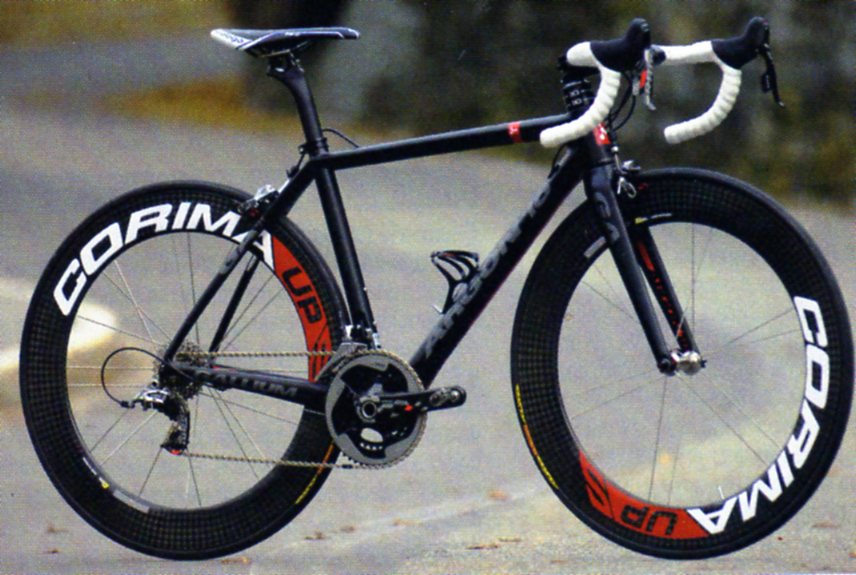
On Caltrain yesterday, I was surprised to see among the usual set of commuting bikes a SRAM Red-equipped Argon Gallium Pro. The bike immediately stole your attention. The design was one which has been trending: clear-coated carbon with plenty of text detail so the viewer is sure to realize he's gazing upon the result of advanced, proprietary engineering and not at yet another paint job on the same old OEM frames being pumped out of the same old Taiwanese factories. But it worked: the bottom bracket area was huge, the downtube a large-diameter "inverted Kamm tail" design seemingly designed to maximize wind resistance, the top tube a broad, eccentric shape which screamed "vertically compliant yet torsionally stiff". All it lacked were the pencil-think seat stays Cervelo popularized, but this was a machine designed for stiffness over anything else. It seemed dramatic overkill, since the bike was small (the Argon "XS" I suspect). There wasn't muc...

Fit change from Cervelo R to 2015 Cervelo S5 geometry

Image
Cervelo's new geometry for the S5 is a move toward the industry standard for stack and reach, with shortened head tubes reducing the stack and increasing the reach of each size. I decided to see what this new geometry did for my fit on the bikes. Would I end up with a hideous tower of spacers? Here's a chart I posted before, with Cervelo S5 2015 replacing the Cannondale Evo. The Cervelo S5 and Evo geometries are fairly close, and so I removed the Evo curve to reduce color. I also show the Trek H1, an example of an aggressive geometry, and the Fuji SL1, which is my bike. My bike is small, with an 11 cm +6 degree stem establishing the position set for me by 3D Bike Fit in San Francisco. Then from those coordinates (to the right of the plot), I trace back to the frame using a variety of stem options, using the head tube angles of the Cervelo R-series bikes. With the R-series (also S2-3, and also the 2014 S5), I could ride a 48 cm frame with a 13 cm +6 degree stem, a 51 c...

new Cervelo S5: reduced stack

Image
Since the retirement of the RS road bike with more "relaxed" geometry, Cervelo has unified its stack-reach schedule, creating a single geometry shared between the R and S series. This geometry is fairly close to the Trek H2 geometry, the more relaxed of the two geometries Trek supports. The logic used by Cervelo is that the vast majority of riders can be fit with a stem ranging from +6 degrees to -17 degrees using this more relaxed geometry. And it's true, but many riders object to a bike like the S5 being touted as an "aero" frame had the longest head tubes. This was especially problematic when using the bike with full time trial bars. Indeed the S5 is sufficiently aero that with time trial bars, it's a competitive time trial/triathlon frame. So a lower stack provides more adjustability and allows more reach for the same stack and a shorter stem for most male riders (small women often benefit from a small reach). Riders claim to prefer the feel of s...

fitting a Cervelo demo R5?

Image
On a recent ride, I found a shop local to the day job, Cupertino Cycles, had a Cervelo Demo R5. Cool! Since reading the RCa White Paper, I've always wanted to try one. Indeed, I've never ridden any of the Cervelo R-series. Recall, perhaps, the Peloton magazine review of the RCa , the prototype which led to the present R5: There is a fury to the way the bike reacts to power -- it leaps from under you, but the feeling continues beyond the initial acceleration. Each pedal stroke delivers a new surge forward. Who wouldn't want to ride this? Deal is the Cervelo geometry is, as I've described, a bit tall. So it isn't obvious what frame to try. But is low-stack over-rates? So what I did is I started with the geometry for the Fuji SL/1, which is my race bike (since I've done little racing recently, the poor thing is getting neglected). I started with the geometry of the size small, which I ride. I use a +6 degree 11 cm stem at present (I used to use a ...

Cervelo geometry: R5Ca versus R5 and RCa

Image
The old R5Ca, Cervelo's first version of a super-high-end stock bike ($10k for the frameset alone, and people, to my amazement, actually paid it...), used a relatively novel geometry whereby the downtube was offset forward of the bottom bracket. With the nominal 72 degree seat tube angle, this in effect gave a seat tube angle which was steeper for shorter bikes, more laid back for taller bikes. In this case by "shorter" and "taller" I mean bottom bracket to saddle. With most manufacturers the same thing is accomplished by changing the actual seat tube angle from steeper in the smallest size (for example, 74.5 degrees) to more laid back (for example, 72.5 degrees) in the largest. But of course the effective STA doesn't then change with the amount of seat post showing. Here's a plot I did: But this was an experiment they didn't pursue. Maybe it caused too much confusion to dealers. I don't know... In the present version of the R5, and the RC...

Canyon versus Storck: Stapel-erreichen Smackdown

Image
I previously showed the Canyon Aeroroad. But Canyon's perhaps more popular bike is the Ultimate, a perennial competitor for Tour Magazine's lab-dominated bike of the year ratings. A prime competitor is Storck, a more niche German company known for its engineering-based approach to bike design. Included in that approach is a relatively unique approach to geometry. Here's a comparison of Trek, Specialized, Canyon, and Storck road bikes, where I've left off the endurance bikes this time: Canyon is clearly sticking to the stack-reach design philosophy with both of its models. And for once a bike company does the obvious which is to make the aero bike lower. And the longest Ultimate is incredibly long. It must be those tall Norwegian customers. But the Storck 0.6 is a bit bizarre. The smallest size differs only in stem length, essentially (actually with the head tube angle being slacker than 73 deg, slammed stem will result in the smallest being slightly higher). Th...

Stack-Reach smackdown: Trek vs Specialized

Image
Last time I compared Trek to Cervelo for stack-reach. The Madone H1 and the even more aggressive Domane Race were much longer/lower than the Cervelo H1, and even lower than the more race-geometry Cervelo R-series from 2008. The Madone H2 and Cervelo R5 were comparable. The Trek Domane 6 was substantially more relaxed than the Madone H2. It's really designed more as a century bike than a race bike, although it may provide a good fit for some racers. Here I compare the Specialized line to the Trek line. I already looked at the 2015 Tarmac. In the following plot, I add in the Roubaix endurance bike as well as the Venge aero road bike: The Venge is basically identical to the Tarmac. The Roubaix is fairly close to the Trek Madone H2, not nearly as relaxed as the Roubaix: around 2.5 cm spacer difference. The Madone H1 is more aggressive than the Tarmac, however: with two lines of Madone they can afford to be more aggressive on the longer/lower version. This suggests for racing...

Stack and Reach of Trek Madone, Domane

Image
Previously I plotted the Trek Madone stack-reach. Consistent with using "race bikes" from other manufacturers, I used the more aggressive of the two geometries, the H1. The H1 used to be called the "pro" geometry, in contrast to the more relaxed "performance" geometry, but Trek decided, apparently, that this implied the more relaxed geometry was a lower standard, compelling weekend warriors to buy bikes which didn't fit them well. So the "pro" became H1, and the "Performance" became H2. In addition to the Madone, the Domane is also a legitimate race bike, sold for comfort at some cost in mass. The standard Domane, as is the standard with "endurance" bikes, has relatively relaxed stack. To compel professional riders, most notably Fabian Cancellara, to ride the frame a lower-stack model needed to be developed. Since the UCI requires bikes given to professional riders be made available to the public, Trek made availabl...

stack-reach comparison: Specialized, Colnago, Felt, Parlee, Cervelo

Image
More stack-reach comparisons, retaining the tall (Cervelo R5) and long (Trek Madone H1) winners from last time: First, there's a new obvious "tall" winner, and that's the Parlee Z5 tall model. Of course this isn't a fair comparison, as it would make more sense to compare the Parlee tall geometry to the endurance geometries of other bikes, but I put this here for comparison since I recently test-rode a Parlee ESX. The regular Parlee Z5 geometry corresponds to around 2.5 cm less spacer height, and has more traditional road racing geometry (clearly not designed to a stack-reach spec, however, since the curve zig-zags). Specialized is interesting, as the smallest 3 models are essentially constant reach, changing only in stack. This is because top tube length is directly canceled by seat tube angle. This keeps the reach the same as the top tube is lengthened. The bikes still fit bigger riders, however: adding spacers to the smaller frames would bring them to a...

Trek Madone, Scott Addict, Cervelo R5, BMC SLR01, Swift Carbon geometry comparison

Image
More bikes added to the stack-reach plot I showed last time. It's tempting to add more and more but I run out of colors, and humans have only 3 color receptors so there's contrast only between so many... Again the mostly vertical blue lines indicate points which can be matched to fit with the same stem but with more spacers on the lower stack, longer reach frame. Spacers reduce reach and increase stack. I additionally added mostly horizontal blue lines, which are spaced by 1 cm spacer height apart, again assuming a 73 degree head tube. These lines would correspond to points which you could reach with the same spacer height, but different length of 0 degree stem. Of course stems aren't typically 0 degrees 6 degrees, 10 degrees, and 17 degrees are popular, and these can be flipped positive or negative. But the spacing between these lines is the key point. For small riders, Cervelo and Swift rule, Swift providing less stack, the Cervelo geometry at this size only rela...

Swift Carbon, BMC SLR, Cervelo old and new: geometry comparison

Image
Last time I noted that Adam Blythe when he switched from the BMC Pro Tour team to the NFTO continental team his stem went to something truly disturbing: a giant horizontal protrusion from the front of his otherwise very nice looking Swift Carbon frame. The obvious explanation is frame grometry: the BMC allowed a lower, longer position than the Swift. So I decided to check this. Here's a plot of reach (x-axis) versus stack (y-axis) as reported by various frame brands (I need to be careful not to say "manufacturers"). I compare the BMC SL01 with the Swift Ultravox Ti, along with two favorite references, Cervelo old (2008) and new (2014). Slight digression: Cervelo decided to take a fresh look at geometry back in those days by setting a seat tube angle of 73 degrees for all frames. They reasoned that the human body when it's shorter or taller is still optimized by the same seat tube angle: the desire for steeper seat tubes in smaller geometries is more driven by ...

low-drop pro bike

Image
Cyclismo-Espresso showed this photo of a United Health Care bike with a Pioneer Power meter mounted. Okay, big deal: I've seen Pioneer power meters on pro bikes before. Apparently they work well enough. What interested me was the remarkably modest handlebar drop. Okay, riders are sometimes limited by the geometry of commercially available frames, but this one has a -6 degree stem and even a spacer under that. This one would get the big reject from SlamThatStem . So I measured the drop. I do that by the following sequence: Load the photo into GIMP . Level the wheels. I used the top of the wheels for this. I had to rotate the photo by 1.0 degrees, according to a measurement with the GIMP measurement tool. Measure the height of the front wheel. This gives me a coversion between distance and pixels. I know the rolling circumference of the wheel is around 210 cm, so this height, in pixels, gives me a conversion. Put horizontal guides at the "saddle point" of the ...

new bike, part 4: Eric Estlund revises geometry

The next step after playing with BikeCad was to send the link to the project to Eric Estlund. Why Eric Estlund? For one, because there's an excellent local shop dealing in randonneuring bikes, Box Dog Bicycles, and they have a stock frame they sell called the Pelican. Jan Heine reviewed it a few years ago and liked it. But since then manufacturing of the Pelican has been transferred to Eric, who is Winter Cycles . I looked at his web site and really liked some of the work I saw. There was no doubt his work was superb. So I sent him an email. And he seemed enthusiastic, supporting my ideas while not afraid to disagree on occasion. That's what I wanted. After all, I don't know anything about these bikes, other than what I read or what I get from talking to others. So I wanted someone who'd drive toward a design without ignoring my preferences. And here's what he ended up with. All in all, I think I did a fairly good job on the initial design, because thi...

new bike part 3: playing with BikeCad

Image
BikeCad is cool. It lets you play around with bike designs and geometries. Bike geometries are generally over-constrained: each dimension depends on other dimensions, so specifying a set of random numbers will not result in a build-able bike. BikeCad takes care of the constraints, doing the trigonometric operations necessary to convert between angles and distances and postions in space. My idea: a randonneuring bike with modern components and a position similar to my Ritchey Breakaway: comfortable but still race-worthy. When I think of randonneuring bikes I think of a bike built to handle anything: rain, rough roads, dirt, pavement, long distances, climbing, descending, carrying supplies, and most importantly speed. Just because I want these other things doesn't mean I don't want a bike which doesn't handle well on descents, doesn't feel responsive on climbs, and won't allow me to pull through on pacelines without eating a wall of wind. I've described m...

revising position & design

Image
During a ride yesterday Cara told me she thought my shoulders looked more relaxed than before. I'd been doing yoga recently and also had had a very nice massage at Doctor's Orders (World Gym, Potrero Hill). I have had a chronic issue with shoulder tightness for as long as I can remember: I tend to sit both on the bike and, more significantly perhaps, at a computer with my shoulders rolled forward. Stay in a position long enough the the body decides there's clearly some natural selection advantage to being there so semi-permanently adapts (this is over-simplistic, I realize). Anyway, I need to constantly focus to rolling my shoulders back, which is to say not roll them forward. The consequence of this on the bike is if I have my shoulders rolled back that brings my chest forward. This means I bend in the hips, lowering my torso. But if my bars are so low my torso is already as low as it can go then this position becomes unsustainable. The only options are straighten...

Playing with BikeCad

Image
I've been playing around with BikeCad , thinking about randonneuring bike designs. I've been fascinated with randonneuring bikes for a few years now, since I started reading Bicycle Quarterly . They seem an excellent option for a wide range of riding, including commuting to work, since a little carrying capacity goes a long way and having a handlebar bag would be super convenient for all sorts of things, liberating me from carrying a backpack for my work clothes, for example, and allowing me to carry more clothing option on certain rides. Fatter tires would be quite nice on the rough roads often encountered around here, and the rolling resistance of performance-oriented 650b/42mm tires has been proven in tests published in Bicycle Quarterly to be quite acceptable. Additionally, Cara wants to do a loaded tour, and while a randonneuring bicycle isn't optimized for a loaded tour, it's far better for that purpose than a traditional racing bicycle. BikeCad is a wonderfu...

fitting pro cyclist setback data, and forward-offset seat tubes

Image
Selected pro cyclist setback data was posted on the WeightWeenies forum. The data are summarized in this spreadsheet . Setback is measured to the tip of the saddle, while saddle height is measured to the top of the saddle. I converted setback to a value Δx, which is the position of the saddle center relative to the bottom bracket, where typical Δx 0 . Here's the result: This is perhaps surprising: the angle is a super-slack 66.4 degrees and the saddle set-back is -93.5 mm. The RMS error is then 16 mm, so the typical rider would have his saddle positioned around 16 mm either forward or behind center. An alternative to negative saddle set-back would be to displace the seattube forward of the bottom-bracket and use a zero-setback post. This is actually what Cervelo has done on several of their bikes, including the R5-CA (see my blog post here ): Cervelo R5-CA uses a seat-post offset forward of the bottom bracket Obviously from the diagram, Cervelo's geometry is a much...

Paris-Roubaix head-tube length record?

Image
This year Cervelo overhauled its road bike geometry, merging the previous R and RS series into a single unified R. I plot head tube angle versus reach for 2010 and 2011 series: the 2011 R series goes from R-like at small sizes up to RS-like in large sizes. On Sunday, Garmin-Cervelo's Johan Van Summeren produced an epic win at Paris-Roubaix riding his modified "R3". Johan's a tall guy: reportedly 2 meters in height, and rides the largest-size Cervelo. From the plot you can see this bike has a 22.5 cm head tube, 2 cm longer than the comparable bike from last year. And you can see every cm of this length in photos of Johan's bike, borrowed from VeloNews: Impressive. Johan is at the limit of the frame's geometry with a slammed -17 degree stem (of course he could have used a retrograde stem to get even lower, but this is generally considered undesirable). This seems to support Cervelo's geometry. But it got me thinking: is this the longest hea...