Posts

Packing Ritchey Breakaway with Powertap wheel: S&S method
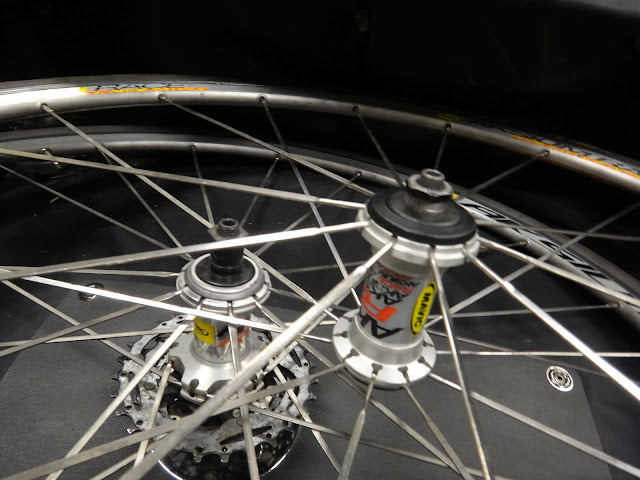
Image
I've never taken my Powertap wheel with me when traveling with the Ritchey Breakaway because of the bulge in the hub. When packing with the Ritchey-recommended method ( see Oleg's blog post ), in which the rear wheel goes in first with the cassette in the bulge in the case, the front wheel goes in immediately after, each hub fitting in gaps of the spokes of the opposite wheel. Wheels go first in Ritchey packing method. Note hubs extend between spokes. ( Oleg's Cycling Adventures ) The Powertap wheel, however, has a bulbous extension on the non-drive side of the hub which prevents them from extending between gaps in the spokes. Without that, the stack height of the wheels is too large. So for years I would just do without the Powertap when traveling. But then I saw Oleg's post on packing the Ritchey using the S&S case method . I was skeptical at first, but sure enough, it all fit without problem. I'm spatially challenged, so needed check, double chec...

Diablo Hill Climb Time Trial (NCNCA championships)

Image
The plan: after running my 50 km race in April, the plan was that I'd do some climb workouts to find my cycling legs again, ride the Memorial Day Ride (MDR), a 4-day supported tour from San Jose to Santa Barbara, to provide the base, then top it off with some hard climbing to get my top end. Running to cycling transitions are easier than cycling to running, in my experience. And running prepares you for the sustained effort of climbing in many ways better than riding does. I'd been able to run essentially continuously for 5+ hours at the Woodside Ramble 50 km. All I needed to do was to push out my top end and I'd be in for a strong Diablo. The truth: I had some solid climb workouts, albeit slow, before MDR. MDR left me tired, compounded by other life pressures like work, looking for a new place to live, and finally dealing with the process of organizing my life to move. My weekends were essentially dead, and my Caltrain commute is crippling to my weekdays, leaving S...

more Vector - Powertap power comparisons

Image
After the last comparison, which was a ride with some steep hills in San Francisco, I did a few more rides comparing Vector to Powertap. On that previous ride, my maximal power curve had been somewhat depressed on the Vector. Further investigation showed it appeared to be due to two points where cadence anomalously dropped on the Vector (but not the Powertap). Since Vector multiplied force by cadence by crank length to get power, if any of the three is off, the power is off. The first of these two rides was a spin around Mountain View at lunch, stopping along the way to drop a package at the post office, then pick up some cherries at the local market (Ava's), then after a bit of a loop, a stop at Trader Joe's for figs and apricots. I made good use of my handlebar bag, combing some solid power efforts with fresh summer fruit for the afternoon. Here's the maximal power curve from that ride: The next day I rode into work with SF2G, the Dawn of the Dead variant of Bayway....

balanced alternative to least-square linear fit

Image
Last time I showed a comparison of Powertap to Vector power with a least-square line through the points. I noted this was "hard to interpret". Here's why. A traditional least-square fit begins by assuming that the x-values are perfectly known, the y-values are uncertain. It additionally assumes that the y-values are normally distributed, with a Gaussian probability distribution, with the error distribution the same for all points, or with variances inversely proportional to the weighting factors for a weighted least-square fit. This seems like a lot of technicality, but it introduces subtle biases in the result when comparing two values whcih contribute relatively equally to the error. For example, consider my power comparison for the Garmin Vector to the Powertap: The slope was 0.97. Therefore, if I flip the axis the slope should be 1.03%. If the Vector is 3% lower than Powertap than the Powertap is 3% more than Vector, on average. But that's not what I ...

Old La Honda: 3rd week in a row

Image
Today was my third consecutive week of Old La Honda. So I moved the Powertap wheel to the Ritchey Breakaway and took that to work. At the start, my legs felt fairly good. I'd ridden into work Tue morning (75 km) with some moderate intensity. On Monday I'd ridden a short ride with some brief efforts, mostly on the flats, partly to compare Vector to Powertap on the Winter Allaban. Sunday I'd done nothing. Saturday I'd done some steep hills, again to compare Vector to Powertap. So there'd been no really depleting rides in the bunch. If I had one thing against me my calories the previous day had been on the low side, considering I'd ridden in. It was nice seeing my old friend Randy at the start. He'd been traveling and it was good hearing about that. Also there was Chris & Greg, two very fast climbers. Kieran wasn't there, nor was Mark. This was to be the last Wed noon ride before the NCNCA championship race on Saturday, up the north face of Mo...

Vector - Powertap data comparison: crank length fixed in Edge 800

Image
Last time I compared Powertap to Vector on my Winter Allaban, I had failed to properly set the crank length on the Garmin 800. I'd set it on the Vector, but the menu item on the Garmin is a bit tricky to find, as it only appears when it is in communication with a Vector, so if you scan the menus without activating the Vector and pairing the Edge to the Vector you'll never see it, as I did not. I actually first confirmed my Edge was asserting the wrong cranklength by running the settings.fit file through fitdump. But this is a digression. I basically repeated my first calibration ride, heading steep 14th Street to Buena Vista in San Francisco and doing one-legged climbing on a more gradual grade, then riding home and doing a sprint. I previously did three comparisons where the maximal power curves of the Powertap and Vector were remarkably coincident after I scaled one of the powers by an empirically determined factor close to the 85% value which I later discovered was the r...

A Tale of Two Sprint Workouts

Image
Thursday of both last week and this week I did a sprint workout. This involved cruising over the Sunnyvale Trader Joes, buying some rice tortillas, goat chedder, and organic blueberries, stuffing them in my pocket, then cruising residential Sunnyvale streets to the Steven's Creek trail. Along the way, on roads of relatively smooth pavement and with enough length between intersections, I do some sprints (4 each of the weeks). Then I cruise the Steven's Creek trail back across the freeway mess and do a few more (2 the first week, an extra the 2nd week when I sprinted for a green light). I'm not sure how much these help the sort of riding I do. But I think improving the top end potentially offers benefits at lower powers, as well as if I need to put in hard efforts to close gaps. I've not been a position where I was sprinting to win races in quite a long time. But sprint repeats challenge multiple aspects of riding: muscle strength, neuoromuscular coordination, pedal ...